
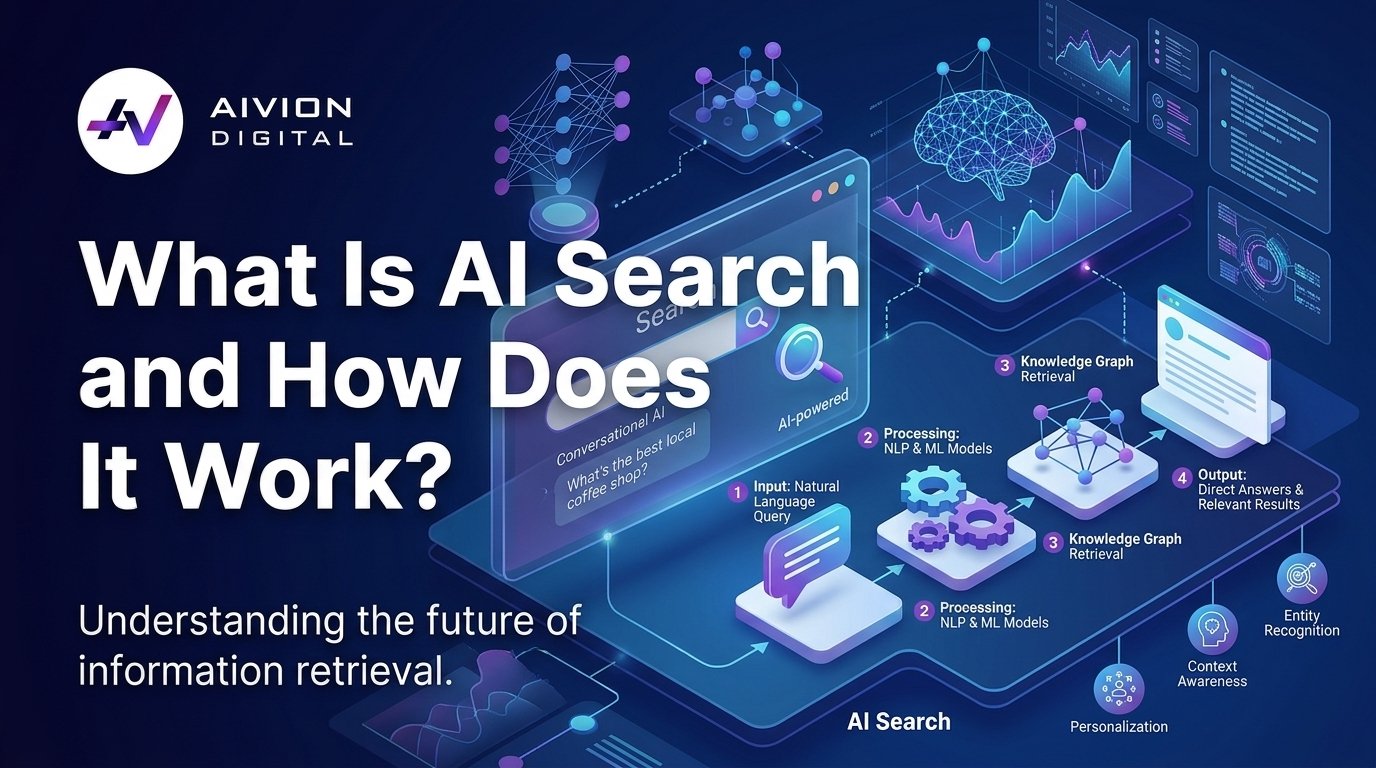
AI search uses artificial intelligence to understand what you are asking and give you a helpful answer, not just a list of links. Instead of matching a few keywords, it interprets the meaning behind your question, finds relevant information, and often writes a short summary in plain language. This matters because people now ask longer, more detailed questions online, and businesses need to be part of those answers. At Aivion, we help brands get found in both Google and AI search. This guide explains how it all works.
What Is AI Search?
AI search is a way of finding information that relies on artificial intelligence to interpret queries, retrieve relevant content, and present results or synthesized answers. You can type a full question the way you would ask a person, and the system tries to grasp what you mean.
A conventional search engine mainly returns a ranked list of web pages. An AI-powered search experience can do that too, but it may also combine information from several sources into one conversational answer. The two approaches often overlap, and many search engines now offer both.
How Does AI Search Work?
The exact process varies by platform, but most AI search systems follow three broad steps.
Understanding the User’s Query
First, the system reads your question. It uses natural language processing, a field of AI that helps computers work with human language, to identify the topic, the context, and the search intent behind your words.
For example, “best laptop for editing video on a budget” signals a purchase decision with a price limit. The system understands that you want recommendations, not a definition of a laptop.
Finding Relevant Information
Next, the system looks for information that matches your need. Traditional search engines use web crawling, where automated programs visit pages and store them in a search index, a huge organized database. Many AI search tools use a similar index to find relevant sources.
Semantic search helps here. It matches meaning rather than exact words, so a page about “cheap video editing computers” can still match your query. This is also why clear, well-structured pages perform better, and why a solid technical SEO foundation still matters. If crawlers cannot read your site, neither search engines nor AI tools can use it.
Some platforms retrieve fresh information from the web when you ask. Others rely mainly on what the AI model learned during training, which is one reason answers differ between tools.
Analyzing Sources and Generating Answers
Finally, an AI model reads the retrieved material and writes a response. Many systems use a method called retrieval augmented generation, often shortened to RAG. In simple terms, the system first retrieves relevant documents and then asks the language model to write an answer based on them. This can make responses more grounded than answers drawn from memory alone.
Some platforms show source citations so you can check where the information came from. Not every platform does this, and citation quality varies.
What Technology Powers AI Search Engines?
Several connected technologies work together behind the scenes.
- Artificial intelligence and machine learning: Machine learning algorithms learn patterns from large amounts of data. They help rank results and predict what is useful.
- Natural language processing: This lets systems read questions and text in everyday language.
- Large language models: These are AI models trained on vast amounts of text. They can summarize, explain, and write human-sounding answers.
- Neural networks: These layered computing structures power many modern language models.
- Semantic search: This connects queries to content by meaning, which improves relevance for complex or conversational questions.
Together, these tools help a system interpret meaning, find the right information, and turn it into a clear response.
What Are Examples of AI Search Engines?
The label “AI search” covers several kinds of products. It helps to separate them.
AI features inside traditional search engines. Google AI Overviews adds AI-generated summaries to standard search results, while Google AI Mode offers a more conversational way to explore a topic. Microsoft Copilot brings AI answers into Microsoft’s search and assistant experiences.
Search-focused AI platforms. Perplexity is built around answering questions with cited sources, which makes it closer to a dedicated generative search engine.
AI assistants with search abilities. ChatGPT Search lets the ChatGPT assistant look up web information and respond conversationally. Gemini is Google’s AI assistant and also supports search-style questions.
These products differ in design, data sources, and features, and they change often. Check each platform’s current description before relying on a specific capability.
AI Search vs Traditional Search
| Factor | Traditional Search | AI Search |
|---|---|---|
| How results are presented | Ranked list of links on a results page | Conversational answer, often with links or cards |
| How questions are interpreted | Strong focus on keywords, with growing use of intent | Designed for full questions and follow-ups |
| How information is summarized | Short snippets from individual pages | Summaries that combine multiple sources |
| How sources are displayed | Each result links to its own page | Citations or source lists, depending on the platform |
| How users explore more | Click through and refine the search | Ask follow-up questions in the same conversation |
These approaches are not rivals in every case. Many search engines blend ranked results with AI-generated summaries, so you often get both in one place.
What Are the Benefits and Limitations of AI Search?
Benefits
- Faster information discovery: You can get a summary without opening many pages.
- Better handling of complex queries: Long, multi-part questions are easier to ask.
- Conversational answers: Follow-up questions keep the context of earlier ones.
- Multiple source synthesis: The system can pull ideas from several places into one explanation.
Limitations
- Inaccurate answers: AI can state wrong information with confidence.
- AI hallucinations: A model may produce details that sound believable but are not true.
- Outdated information: Some tools do not retrieve live data, so answers may lag behind current events.
- Incomplete or weak citations: Sources may be missing, unclear, or not fully support the claim.
- Privacy considerations: Questions you type may be stored or used under a platform’s policies, so avoid sharing sensitive personal details.
For anything important, such as health, money, or legal decisions, verify the answer against reliable sources.
Why AI Search Matters for Your Business
When someone asks an AI tool for a recommendation in your field, it usually names only a few businesses. If your brand is not among them, you lose a potential customer before they ever reach your website.
AI tools tend to draw on content that is clear, trustworthy, and easy to understand. That makes good SEO fundamentals more important, not less. Strong pages, accurate information, and quality SEO content give both Google and AI systems something worth citing.
How Aivion Helps Your Brand Appear in AI Search
At Aivion, we build on real SEO and then extend it to AI search. Our team helps businesses with:
- Generative Engine Optimization (GEO) to make your content easier for generative search tools to use.
- Answer Engine Optimization (AEO) to structure content so it can answer direct questions.
- LLM SEO to improve how your brand appears in large language model responses.
- AI Citation Optimization to help your site become a source AI tools can reference.
No one can promise a specific mention in any AI answer, because each platform works differently. What we can do is strengthen the signals that help your brand get found, understood, and trusted. If you are unsure where your website stands today, a free SEO audit is a good place to start.
Frequently Asked Questions About AI Search
What Is an AI Search Engine?
An AI search engine is a search tool that uses AI to understand questions and return answers, summaries, or results based on meaning. Some are standalone products, while others are AI features added to existing search engines.
How Is AI Search Different From Google Search?
Google Search is a traditional search engine that mainly ranks web pages, though it now includes AI features such as AI Overviews. AI search more broadly refers to experiences that interpret questions conversationally and summarize information. The line between them keeps getting thinner.
Can AI Search Engines Provide Accurate Answers?
Often, but not always. They can make mistakes, miss context, or rely on weak sources. Check citations and compare important answers with trusted references.
How Do AI Search Engines Find Information Online?
Many use a search index built by web crawling, and some retrieve fresh pages when you ask. Others lean on training data. The method depends on the platform.
What Are the Main Benefits of AI Search?
The main benefits are quicker discovery, easier handling of complex questions, conversational follow-ups, and summaries that bring several sources together.
Conclusion
AI search uses language understanding, retrieval systems, and language models to interpret your question and present a useful answer. It builds on traditional search rather than replacing it, and many tools now combine both. For users, it means faster discovery. For businesses, it means being visible in more places than a results page. Still, AI answers can be wrong or outdated, so always check important details with reliable sources.
If you want your business to show up on Google and in AI answers, talk to the Aivion team and we will help you find the right starting point.
For More information, visit our Facebook Page.