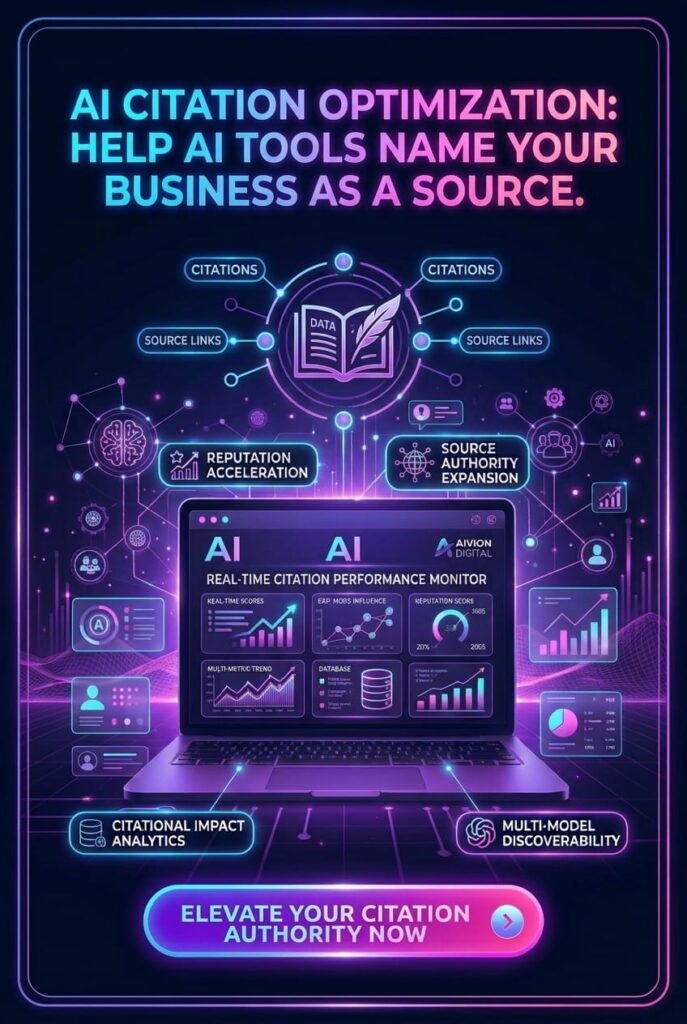
An AI citation is a link or named reference to your website or brand inside an AI-generated answer. AI citation optimization is the work of improving the chances that AI tools choose your business as one of those sources, and that they describe it correctly when they do.
AI tools don’t pick sources at random. They tend to favour pages that answer the question clearly, come from a recognisable and credible source, and are backed up by what other trusted sites say. They also need to be able to read the page in the first place.
So the work covers four areas: content, credibility, entities, and technical access. It builds on traditional SEO and works alongside Generative Engine Optimization and LLM SEO, which look at the same shift from slightly different angles.
A citation works like a recommendation made at the moment someone is researching. The reader sees your name next to a direct answer, which can build trust before they’ve even visited your site.
This matters in Malaysia, where people search in English, Bahasa Malaysia, Chinese, and mixed-language phrasing, and where many buyers compare several suppliers before they make contact. AI tools suit that kind of question-led research, so the sources they name carry weight.
Good citation work can help you:
1. Discovery. We learn your goals, markets, customers, and the questions that matter commercially.
2. Review and Baseline. We assess your current citations, content, credibility signals, entities, and technical access.
3. Strategy. You receive a prioritised plan with clear actions and responsibilities.
4. Implementation. We carry out the agreed work on content, entity signals, technical setup, and source opportunities.
5. Monitoring and Refinement. We track changes, report what we see, and adjust as AI platforms evolve.
It’s the process of improving your content, credibility signals, entities, and technical access so AI tools are more likely to cite your business as a source and describe it accurately.
No. AI platforms control their own answers, and those answers can vary between users and over time. We improve the factors within our influence and measure the results openly.
We focus on ChatGPT Search, Perplexity, and Google AI Overviews, and the principles apply to other AI search tools too. For platform-specific detail, see our ChatGPT Search optimization, Perplexity SEO, and Google AI Overviews optimization pages.
Traditional SEO focuses on ranking pages in search results. Citation optimization builds on it and adds attention to quotable content, credibility signals, entities, and third-party mentions. See our AI SEO services for how the pieces fit together.
Often, yes. We trace where the wrong information comes from, such as outdated pages or inconsistent listings, and recommend fixes. We can’t edit what AI tools say directly, but correcting the sources usually improves the answers.
Content and technical improvements can show early movement within a few months. Authority and third-party mentions usually build over a longer period, depending on your industry and competition.
We track which of your priority questions cite your site, how your brand is described, and how that changes over time. You get plain-language reports, without vanity metrics.
It depends on your website, competition, and scope. We provide a custom quote after an initial review.