Your products are live. Your pages look fine. But Google Search Console says some pages aren’t indexed, others have errors, and traffic isn’t moving. Most of the time, the cause is technical. Our ecommerce technical SEO services at Aivion Digital help Malaysian online stores find those hidden problems and fix them in order of importance.
We audit how search engines crawl and read your store, then give you a clear list of what to fix and why. The work is built around your platform, your catalogue and your goals.
It suits stores of any size, though it matters most for large catalogues and stores that have recently migrated, redesigned or added many plugins or apps.
Ecommerce technical SEO is the work of making sure search engines can find, crawl, read and index your store properly. It’s about the foundations, not the copy.
Online stores create technical problems that most websites never face. One product can have several URLs. Filters and sorting options generate thousands of extra pages. Products go out of stock, get discontinued or change variants. Prices and availability change daily. Each of these can quietly cause errors.
When these issues pile up, Google may skip good pages, index the wrong ones or show outdated product details. Technical SEO fixes that.
You can write great product content and build good links, and still get little from search if technical problems block the way. Think of it as fixing the road before sending more traffic down it. Here’s what solid technical SEO can do for your store:
Products that aren’t indexed can’t rank or bring in sales.
On large stores, Google can spend its time on filter pages and duplicates instead of your real products.
Clean schema helps price, availability and reviews appear correctly in search results.
Faster, more stable pages on mobile help visitors stay and buy.
Regular checks catch problems from updates, migrations and new plugins before they cause damage.
Content and links perform better when the foundation is sound.
Results depend on your competition, your site’s condition and how much work is needed. We’ll tell you honestly what’s realistic.
Products can be missing from Google for many reasons: blocked by robots.txt, tagged noindex by mistake, weak internal links, soft 404 errors or crawl problems. We find the cause for each group of pages and fix it.
Filters, sorting options, tracking parameters and endless pagination can create thousands of low-value URLs. Google may spend its time there instead of on your products. We bring crawling back to the pages that matter.
Variants, categories, parameters and copied manufacturer content can produce near-identical pages. Wrong or missing canonical tags make it worse. We set clear rules so Google knows which URL to rank.
Discontinued products, changed URLs and old redirects leave broken paths behind. These waste crawl budget, frustrate shoppers and can lose link value. We map out the right handling for each case, including out-of-stock and discontinued items.
Missing prices, wrong availability, broken review markup or validation errors can stop your listings from showing rich details. We check, fix and test your structured data.
Heavy images, sliders, apps, plugins and third-party scripts slow pages down, especially on mobile data. We find what’s dragging each page and recommend fixes your developer can act on.
Some stores load products, prices or links through JavaScript in a way search engines struggle to read. We test how Google actually sees your pages and flag what’s being missed.
Products that no other page links to are hard for Google to find and rank. We review your category structure, breadcrumbs and internal links so every important product is reachable.
If you sell in more than one country or language, wrong hreflang setup can send shoppers to the wrong version of a page. We check and correct it.
New platforms, themes and URL changes can cause sudden drops. We help you recover and protect what you already have.
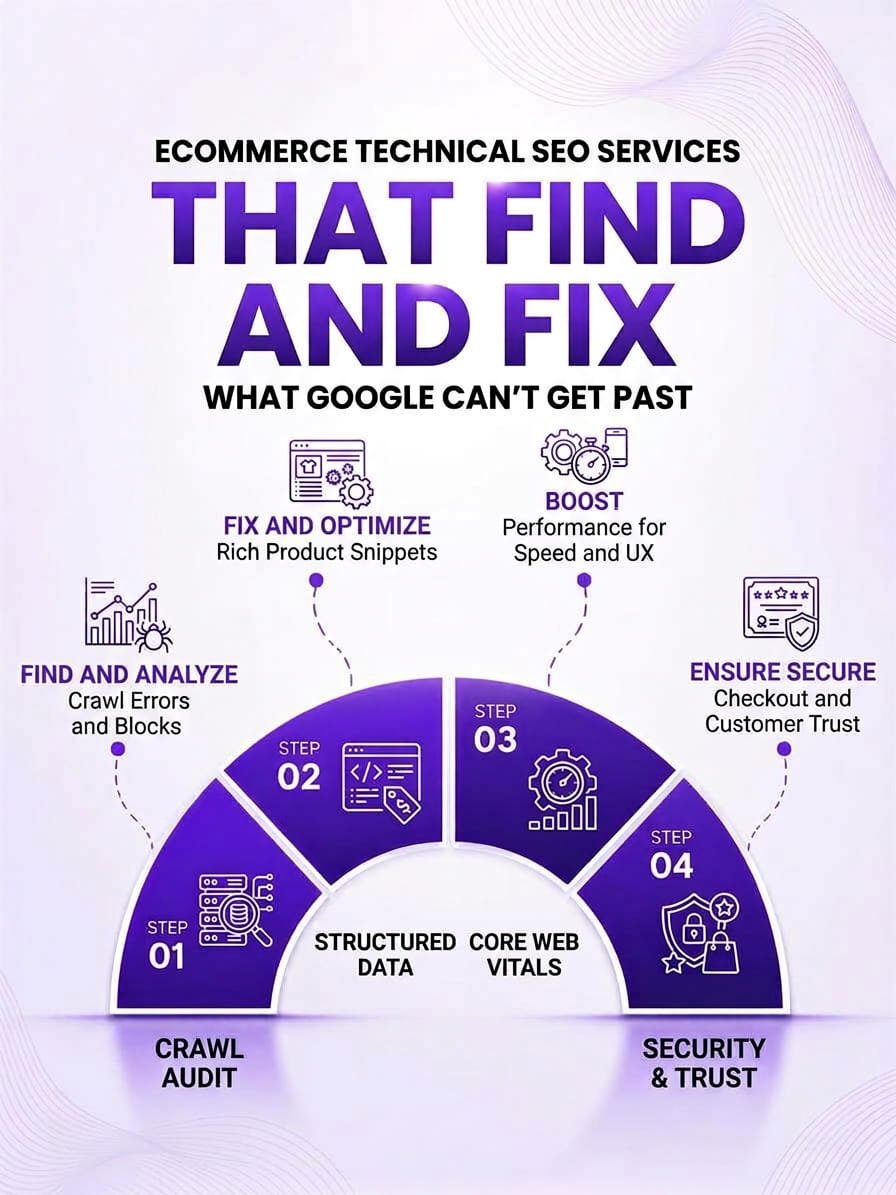
We start with a full review of your store. We crawl the site, check Google Search Console data, review server and log signals where available, and test key templates. You get a prioritised report that explains each issue, why it matters, how serious it is and how to fix it.
We check what Google can reach and what it chooses to index. That includes robots.txt rules, noindex tags, XML sitemaps, internal links, orphan pages and parameter URLs. We then recommend rules that guide Google toward your valuable pages.
We review how products, categories and filters connect. We look at click depth, breadcrumbs, pagination and related product links, and suggest changes that make your best pages easier to find.
We identify duplicate product pages, variant URLs and repeated titles or descriptions. Then we set canonical rules, parameter handling and consolidation plans so each product has one clear version.
We find 404s, soft 404s, redirect chains and incorrect status codes. We create a handling plan for out-of-stock and discontinued products, and map redirects for changed URLs.
We check product schema for missing or invalid fields, including price, availability, brand and review markup. We also review breadcrumb markup. Review and rating schema is only recommended where genuine reviews are visible on the page.
We test product, category and key pages on mobile and desktop. We identify what slows them down, such as image size, scripts, apps, fonts and server response, and give clear fixes.
We check how your store works on phones, including layout, tap targets, popups and product page usability.
We compare what shoppers see with what Google sees, and flag content or links that may not be read properly.
Where relevant, we check hreflang, language and country URL structure and duplicate versions across markets.
We give your developer clear, step-by-step instructions, or we coordinate with them to get changes live. Where agreed, we handle changes ourselves.
After fixes go live, we keep checking indexation, errors and performance, so new problems are caught early. Reports explain what changed and what it means, in plain language.
If you also need help with the pages themselves, see our product SEO services.
Choosing an SEO partner is a trust decision. Here’s what you can expect from us:
We look at your actual store, data and platform before recommending anything.
You’ll know what’s urgent, what can wait and why.
We write recommendations your developer can follow without guessing.
We understand variants, filters, stock changes and catalogue-scale problems.
We consider mobile-first shoppers, marketplace competition and local and regional selling.
We don’t promise guaranteed rankings or instant results. No one can honestly do that.
You’ll understand what’s happening without decoding jargon.
Once we understand your store and goals, we’ll recommend a scope and give you a clear quote.
We don’t use a one-size-fits-all package, because every store is different. Pricing depends on:
Pricing depends on your store size, platform, the number of issues and how much implementation you want us to handle. We review your store first, then give you a custom quote with a clear scope.
Some fixes, like removing a noindex tag or correcting canonicals, can show effects within weeks. Others take longer because Google needs time to recrawl and reassess pages. Timelines depend on your site’s condition and competition. We’ll set realistic expectations after the audit.
No. Search engines make the final decisions, so no honest agency can guarantee rankings or revenue. What we offer is a clear diagnosis, quality work and transparent reporting.
We crawl your store, review Google Search Console data and check indexation, duplicate content, status codes, structured data, speed, mobile usability, rendering and internal links. You get a prioritised report that explains each issue and how to fix it.
There are many possible causes, including noindex tags, robots.txt blocks, weak internal links, duplicate pages, soft 404s and rendering problems. An audit identifies the exact reason for your store.
Either. We can hand your developer detailed instructions and support them, or implement agreed changes ourselves where your platform and access allow.
Yes, the issues we look for apply across platforms, and we adjust our approach to each one’s limits. Tell us your platform and we’ll confirm how we’d handle it.
You’ll get regular reports on issues fixed, indexation, errors, speed and organic performance, in plain language and focused on what matters to your business.